

Stake Mines: How to Play, Multiplier Chart & Calculator

Stake Mines rules, payout multipliers and odds calculations for safe picks

Stake Mines hides between 1 and 24 mines on a 5×5 grid of 25 tiles, and every gem you uncover raises the multiplier. You choose how many mines go on the board and when to cash out, so one tap can bank the win or end the round. The in-house title runs at a 99% RTP and opens in demo without an account. Play your first round free in demo, then switch to real money when you are ready.

Stake Mines rules, payout multipliers and odds calculations for safe picks

How Stake Mines Works

The game of Mines at Stake comes down to two decisions: how many mines to place, and when to stop. More mines mean fewer gems on the grid and a faster-climbing multiplier, because each safe pick beats longer odds than the one before. The default is 3 mines. The slider runs from 1 to 24, and the gem count adjusts to fill the rest of the 25 tiles.

  1. Enter your Bet Amount in the Manual tab.
  2. Set the number of mines on the Mines slider.
  3. Pick tiles one by one, or tap Random Pick to let the game choose.
  4. Press Cashout at any point to collect the current multiplier; a mine ends the round and the bet is lost.
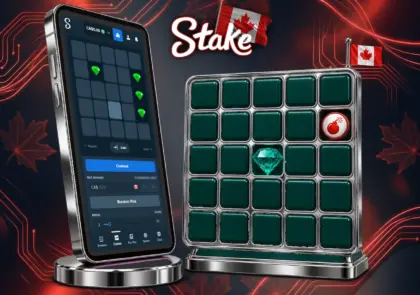
Choosing a mine count, revealing safe tiles and deciding when to cash out

Stake Mines Chart: Multipliers by Mine Count

The table shows the payout after a given number of safe picks, taken from the game’s own paytable. Rows follow the mine count, columns the number of gems opened. The last column is the top prize for that setting, paid when every gem on the board is open.

Payout multipliers by mine count and number of gems revealed
Mines1 safe pick3 safe picks5 safe picks10 safe picksAll gems
11.03x1.12x1.24x1.65x24.75x
31.13x1.48x2.00x5.00x2,277.00x
51.24x2.00x3.39x17.52x52,598.70x
101.65x5.00x17.52x1,077.61x3,236,072.40x
2424.75xNot possible: 1 gem on the gridNot possible: 1 gem on the gridNot possible: 1 gem on the grid24.75x

Mines Odds and What a Calculator Shows

Every pick is a simple fraction. At 10 mines the first pick is already only a 60% shot, 15 tiles out of 25. With 3 mines, your first tile is safe 22 times out of 25, an 88% probability. The next pick has one gem fewer and one tile fewer, so it lands safely 21 times out of 24.

Multiply the two and the chance of surviving both picks is 77%. A fair price for that risk would be 1.30x, and the game pays 1.29x, because the multiplier already contains the 1% house edge. Push on to five picks and the odds of getting through drop to 49.6%, which is why the board shows 2.00x at that point.

A mines calculator for Stake does exactly this sum for any mine count and any number of picks. It returns the chance of surviving and the multiplier you would see, nothing more. No calculator and no mines strategy can tell you where the next mine sits, since the positions are fixed before the round starts. Here is how the odds look at a few settings:

A Mines calculator estimates safe pick probabilities and corresponding payout multipliers
  • 3 mines, 2 picks: 77% to survive, 1.29x;
  • 3 mines, 5 picks: 49.6% to survive, 2.00x;
  • 10 mines, 10 picks: about 0.09% to survive, 1,077.61x;
  • 24 mines, 1 pick: 4% to survive, 24.75x.

Stake Mines Demo

The demo of Mines on Stake uses play money. No account is needed: the Demo toggle under the game shows before you log in. It is the cheapest way to feel how fast a 10-mine board ends compared with a 1-mine board, and how often a five-pick run survives at each setting. A demo streak says nothing about the next real round, since every round runs on new seeds.

Trying different mine counts with virtual credits before playing for money
  1. Open Mines from the Stake Originals shelf.
  2. Switch the toggle under the game window to Demo.
  3. Try different mine counts and watch how the multiplier and the busts change.

Is Stake Mines Rigged?

The short answer is no, and the game’s maths shows why. Mine positions are set before each round from a server seed and your client seed, and the server seed is shown to you in hashed form before you bet. Once you rotate the seed pair, the old server seed is revealed, and any past round can be recomputed in the Verify tab of the Fairness window. The Seeds tab shows the Active Client Seed, the Active Server Seed (Hashed) and the number of bets made with the pair, and you can type a new client seed and rotate the pair whenever you like. Provably fair means the result was fixed in advance and can be checked, not that a round will win.

The house edge is published and identical at every setting. Each multiplier in the chart equals 99% of the fair price, whether you play with 1 mine or 24.

How server and client seeds let you verify past Mines rounds

Auto-Bet and Bet Limits

Auto bet repeats the same round for you, so set your limits before you press start. It uses the same paytable and the same 1% edge as manual play, which means it changes the pace, not the odds. Mark the tiles you want on the board, where they turn purple, or switch on Random Pick, then fill in the Auto tab and press Start Autobet:

  • Number of Bets, where 0 means no limit;
  • On Win and On Loss, to reset the bet or increase it by a percentage;
  • Stop on Profit and Stop on Loss, the two amounts that end the run automatically.
Setting round limits and stop thresholds for automated bets

Mines on Stake: FAQ

How many mines should I pick?
It depends on the risk you want. More mines pay faster but end rounds sooner; the 1% edge stays the same at every count.
Is there a mines strategy that works?
No system beats the edge. Mine positions are fixed by the seeds before you click, so your choice of tiles cannot change the odds.
Is this the same as Spribe Mines?
No. Spribe makes a different game with the same name, while the Original built by Stake has its own paytable and seeds.
What is the max multiplier?
5,148,297x, reached with 12 or 13 mines when every gem on the grid is uncovered.
Can I play Mines free?
Yes. Switch the toggle under the game to Demo and play with virtual credits, with no account needed.