
The Plinko game Stake built has a bet plus two board settings, rows and risk. More rows add more bounces and more landing slots, from 9 slots at 8 rows to 17 at 16 rows, while a higher risk level pushes value out to the edges of the board. Neither setting changes the 1% house edge, and the slot values on screen update as soon as you change the risk level. Each peg sends the ball left or right, and the multiplier printed on the slot where it stops is what you win; any slot under 1x returns less than your bet.
Stake Plinko: How to Play, Demo & Multipliers (2026)
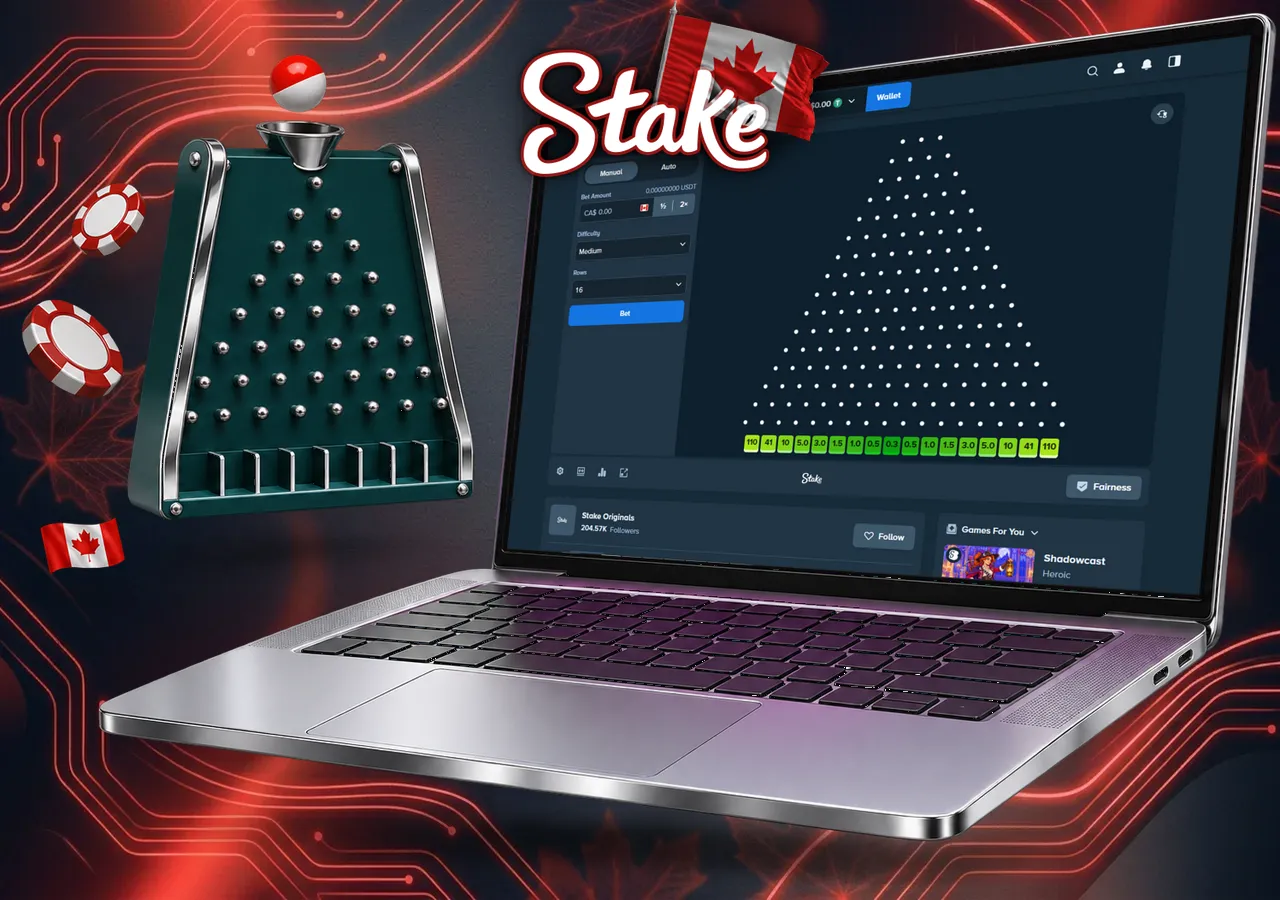
Plinko at Stake drops a ball through rows of pegs into a line of multiplier slots, and the slot it lands in sets your payout. You choose 8 to 16 rows and one of four risk levels, and those two settings decide how wide the payouts spread, up to 10,000x. The game runs free in demo mode without an account. Play your first drop of Stake Plinko today.
How Plinko Works at Stake

- Enter your bet amount in the Manual tab.
- Choose between 8 and 16 rows.
- Pick the risk level: Low, Medium, High or Expert.
- Press Bet to drop the ball, or switch to Auto, enter the number of drops and start the run with the same rows and risk on every ball.
Plinko Multipliers by Rows and Risk
The Stake game Plinko pays the most at the two edge slots and the least in the centre. Medium risk sits between Low and High, with 13x at 8 rows and 110x at 16. Expert risk reaches 10,000x. On smaller boards it tops out at 50x with 8 rows and 619x with 12, which is still far above the High risk edge on the same board.

| Rows | Risk | Edge multiplier | Centre multiplier |
|---|---|---|---|
| 8 | Low | 5.6x | 0.5x |
| 8 | High | 29x | 0.2x |
| 12 | Low | 10x | 0.5x |
| 12 | High | 170x | 0.2x |
| 16 | Low | 16x | 0.5x |
| 16 | High | 1,000x | 0.2x |
Stake Plinko Demo: Play Free
The Stake Plinko demo uses play money and needs neither a deposit nor an account, because the Demo toggle under the game shows before you log in. Stake Plinko free play is the cheapest way to see how differently Low and High risk behave over a hundred drops. Auto mode works in demo too, so you can run a long series in seconds and look at the spread of results. Originals open in demo straight away. Demo results never carry over to a real-money session, and every round runs on new seeds.

- Open Plinko from the Originals shelf.
- Switch the toggle under the game window to Demo.
- Try each risk level at 8 rows and at 16, and watch where the balls land.
Plinko RTP and Fairness
Plinko returns 99% over the long run, which leaves a 1% house edge. That figure is the same at every row count and every risk level: rows and risk change volatility, not the price you pay per drop.
Each drop is provably fair and is built from 8 to 16 separate bounce results, one per row. The left-or-right bounce at every row comes from your client seed, a server seed shown to you as a hash before you bet and a nonce that counts your drops. Rotate the seed pair in the Fairness modal to reveal the old server seed, then recompute any drop in the Verify tab and match it against your bet history. The Calculation page in the provably fair section on stake.com runs the same check outside the game. Provably fair shows that a drop was not changed after you bet; it does not make any slot more likely.

Plinko Strategy: What Changes and What Doesn’t
Low risk gives frequent small returns, and High or Expert risk gives rare large ones. At 16 rows the ball lands in the centre slot 19.64% of the time, while each edge slot catches it only once in 65,536 drops, or 0.0015%. At 12 rows the centre takes 22.56% and each edge 0.024%. At 8 rows the centre takes 27.34% and each edge 0.39%, so fewer rows bring the big slots much closer but make them smaller.
More rows widen the range of results in both directions. At High risk the centre slots drop to 0.2x, which means most drops return a fraction of the bet while a few hit 26x, 130x or more. Over thousands of drops every combination still averages out at 99%, which means $1 of expected cost for every $100 you drop, whatever the setting. No betting system, row count or risk level beats that edge, and a pattern in the last 50 drops says nothing about the next one.
What you can control is how fast a session moves and where it stops:

- Set a budget for the session before the first drop, and size each bet as a small share of it;
- Use Auto with a fixed number of drops, so the session ends on its own instead of running until the balance is gone;
- Match risk to your budget: Low risk at 16 rows stretches a balance because no slot pays under 0.5x, while Expert at 16 rows can empty it quickly;
- Stop after a target win or a set loss, and do not raise the bet to chase a losing run.
Stake Plinko FAQ
Is there a Plinko Stake demo?
Yes. Switch the toggle under the game to Demo and drop balls with virtual credits, no account or deposit needed.
What is the best risk level?
It depends on the swings you want. Low risk pays small and often, Expert rarely but big, and the 1% edge never changes.
What is the max multiplier?
10,000x, on the edge slot at 16 rows with Expert risk. High risk at 16 rows tops out at 1,000x.
Is Plinko rigged?
No. Each bounce comes from seeds you can verify after the drop, and the 99% RTP is published with the game.
Is it the same as Plinko on Stake.us?
The game type is the same, but Stake.com is a separate site where you play in CAD or crypto rather than in coins.